)
A dog arrests during treatment. One technician starts chest compressions. Another manages ventilation and vascular access. The veterinarian leads the response while the recorder tracks CPR cycles, medication times, rhythm checks, ETCO₂, compressor changes, and whether the patient achieves ROSC.
In a critical event, a lot happens in a short period of time. Once the emergency is over, exact timings, interventions, and changes in the patient’s response can be difficult to remember clearly.
A CPR record needs to do more than show that CPR happened. It must preserve important details so the next clinician can understand what happened, continue post-arrest care, and review the team’s response afterward.
In this guide, you’ll learn:
What a useful veterinary CPR record should capture
Which details need to be recorded during CPR and which can be added afterward
How a structured template can reduce documentation gaps during an arrest
How to adapt a CPR record to your practice’s workflow
How digital and AI-assisted documentation can reduce the work of turning the event into a complete medical record
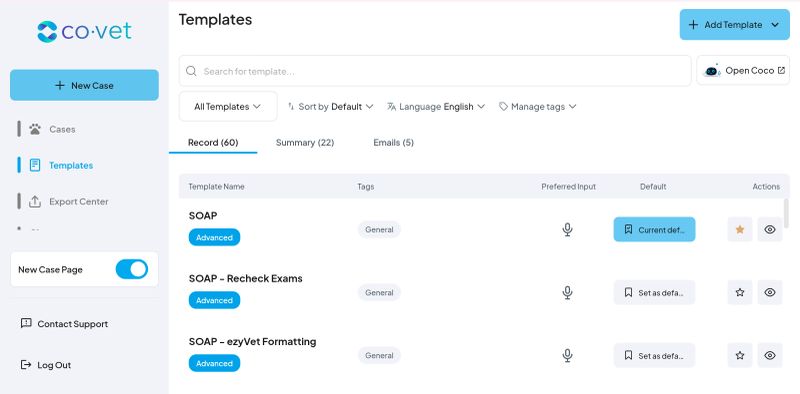
CoVet is an AI scribe built by practicing veterinarians and provides 95+ specialty veterinary medical record templates covering GP, equine, exotics, dentistry, and referral summary templates.
Looking for more specialized templates for veterinary forms?
Browse our complete library of veterinary documentation templates:
What is a veterinary CPR record template and why you need one
A veterinary CPR record template is a structured form for documenting what happens during a cardiopulmonary resuscitation (CPR) event and immediately afterward. It’s the document that the scribe or timekeeper uses to record CPR cycles, interventions, drug administration, patient monitoring, timing, team members, and the outcome.
Having an organized structure is necessary here because CPR, as an emergency procedure, generates information faster than it can be reliably reconstructed from memory afterward.
The RECOVER guidelines provide a shared clinical framework for CPR, while RECOVER's Utstein-style reporting guidelines address standardized reporting of resuscitation events. The 2024 update covers Basic Life Support (BLS), Advanced Life Support (ALS), and periarrest monitoring, while the accompanying guidance emphasizes preparation, training, cognitive aids, and readily available CPR resources.
What a veterinary CPR record helps your team do
A useful CPR record is more than a code sheet or CPR checklist. It should help your team:
Capture the resuscitation timeline as it happens
Record CPR cycles, ventilation, drug administration, ECG and ETCO₂ monitoring, rhythm changes, and other interventions
Connect interventions with the patient's response and eventual ROSC or outcome
Give the next clinician enough context to understand the event without relying on memory or verbal handoff
Preserve enough detail to review the response and identify process problems afterward
RECOVER's Utstein-style reporting framework also includes patient information, location and suspected cause of cardiac arrest, interventions already in place, personnel, ROSC or outcomes, and post-arrest information.
Why standardization matters for a veterinary CPR record template
During a cardiac arrest, different people may handle compressions, airway management, medications, monitoring, timing, and documentation simultaneously. Without a shared format, the person recording the event has to decide what to capture and where to put it while trying to keep up with the team.
This is especially important when CPR happens infrequently. A team may go months between resuscitation events, so relying on everyone to remember the same documentation process is unrealistic. A standardized CPR record gives the team a consistent structure to use when the situation is stressful or unfamiliar.
Here, the RECOVER guidelines for CPR can provide a useful shared clinical framework to document resuscitation events. A structured record can follow the clinical workflow by capturing key information during resuscitation and leaving appropriate details for completion afterward.
The goal is predictable documentation that does not compete with patient care. A structured record can follow the progression of resuscitation and limit unnecessary free-text entry.
How a CPR record differs from other veterinary documentation templates
A veterinary nursing care plan follows the patient's needs throughout hospitalization, while a CPR record captures a short, time-critical resuscitation event.
Template | Primary purpose | Related template |
Veterinary CPR record | Records the sequence, interventions, monitoring, team involvement, and outcome of a resuscitation event | |
Veterinary nursing care plan | Guides nursing care, assessments, interventions, monitoring, and reassessment | |
Veterinary patient rounds | Organizes information for reviewing hospitalized patients and communicating changes | |
Veterinary discharge instructions template | Standardizes post-visit communication and at-home care instructions | |
Veterinary medical record | Provides the broader record of the patient's history, assessment, treatment, and outcome | |
Surgery record template | Records anesthetic protocols, surgical procedures, intraoperative findings, complications, and recovery notes. |
These templates can work together, but they should not be treated as interchangeable. A nursing care plan, for example, translates nursing needs into documented actions and provides a shared reference across shifts. Its related templates include patient rounds, examination, SOAP notes, treatment, and discharge documentation.
A CPR record has a narrower job: preserve the sequence of a high-pressure resuscitation accurately for the rest of the patient's care and later review.
What to include in your veterinary CPR record template
Once you know how a CPR record differs from other veterinary documentation, the next practical step is working out what actually needs to go on the form.
A useful veterinary CPR record template should follow the sequence of the resuscitation itself. Your documentation does not need to reproduce the CPR algorithm, but it should give the team a way to record what happened across those stages.
Start with the information the team needs before CPR begins
The record should establish enough context to identify the patient and understand the cardiac arrest event without making the scribe search through another part of the medical record.
Include fields for:
Patient identification and signalment
Date, time, and location of the arrest
Arrest witnessed or unwitnessed
Relevant medical history or suspected cause, where known
Pre-arrest status and interventions already in place
CPR decision or status, where applicable
CPR leader and team members
Scribe or timekeeper
This follows the wider RECOVER approach for dogs and cats, which considers patient information, the cause and location of the arrest event, interventions already in place, personnel, CPR measures, ROSC, and outcome rather than treating the event as an isolated list of treatments.
The team structure also matters here. A CPR team should have clearly defined roles, including someone responsible for recording and timing events.
During BLS, make the time log do most of the work
One of the most important parts of a CPR record is the real-time event log. During CPR, the team generates information simultaneously: compressions, ventilation, medications, rhythm assessments, monitoring findings, compressor changes, and other interventions.
A good template should therefore let the scribe record these events quickly without writing a narrative.
At minimum, the time log should provide structured fields for:
Compression cycle or cycle number
The time of each cycle
Compressor changes
Ventilation
Rhythm checks
Pulse or ROSC assessment
Interruptions to CPR and their reason
Relevant monitoring findings
Personnel involved
The record should match the clinical workflow the team is already using.
BLS is organized around uninterrupted two-minute compression cycles, with a brief assessment and compressor change between cycles. That means a CPR checklist built as a long blank narrative box does not match the event. A row-based time log is easier to scan and gives the team a clearer record of what happened and when.
Record ALS interventions as events, not just checkboxes
Once ALS begins, the record needs to capture interventions that can affect what happens next.
For drug administration, include fields for:
Drug name
Dose
Route
Time administered
Person administering it
Relevant response or outcome, where appropriate
The same level of detail applies to defibrillation. Record the rhythm, shock or defibrillation event, time, and subsequent assessment rather than simply checking "defibrillation performed."
RECOVER-based CPR guidance for cats and dogs describes ALS as including ECG assessment, ETCO₂ monitoring, vascular access, and administration of drugs or defibrillation based on the identified rhythm.
The template should support those actions without turning itself into a drug chart or CPR algorithm. The clinical team should use the current RECOVER algorithm and drug chart for treatment decisions and the CPR record should document what was actually done.
Give patient monitoring its own place
Monitoring information is easy to lose when it is buried in the general event log. Give ECG and end-tidal CO₂ (ETCO₂) dedicated fields where they are relevant to the case.
For example, the record might capture:
ECG rhythm at each assessment
ETCO₂ readings or relevant changes
Other monitoring findings used by the team
Time of monitoring assessment
Changes that affected the CPR response
RECOVER identifies ETCO₂ as an important monitoring tool during CPR and notes that it can provide information about CPR quality and help identify ROSC. It also identifies ECG as an essential part of monitoring for arrhythmias during ALS.
The point of these fields is not to make the scribe interpret the numbers. They preserve the clinical information the team was already using so another clinician can understand the resuscitation afterward.
Close the record with ROSC and post-cardiac arrest care
The record should not stop when circulation returns.
Include space for:
Time of ROSC
Rhythm and patient status at ROSC
Immediate interventions following ROSC
Respiratory and cardiovascular support
Relevant monitoring
Post-arrest treatment
Final outcome
Transfer or disposition
Any required follow-up or review
Post-cardiac arrest care is a distinct part of the RECOVER framework. The MSD Veterinary Manual's article on CPR for small animals also emphasizes continued monitoring and treatment after ROSC, including oxygenation, cardiovascular support, electrolyte and acid-base status, neurologic status, and other relevant parameters.
This is also where the CPR record hands off to the rest of the veterinary medical record.
Connect the CPR record to the next shift
Once the patient achieves ROSC, information from the CPR record needs to feed into ongoing monitoring, treatment, and handoff documentation. A patient rounds template is useful for this next stage because it organizes interval events, current vitals and monitoring, medications and diagnostics, the updated plan, and client communication for the next team.
The CPR record should therefore capture the arrest clearly enough that the next clinician does not have to reconstruct it before deciding what needs attention during rounds.
The same principle applies if you decide to use a veterinary nursing care plan. That document is designed for ongoing nursing assessment, interventions, monitoring, reassessment, and continuity across shifts rather than documenting the arrest itself.
For emergency and critical care patients, that care plan may need to accommodate frequent reassessment, fluid balance, oxygen and respiratory status, cardiovascular monitoring, pain assessment, escalation, and changes made as the patient's condition evolves.
For practices that use these documents, the result is a cleaner documentation chain:
CPR event → CPR record → ongoing patient monitoring and nursing care → patient rounds and handoff → broader veterinary medical record.
A strong small-animal veterinary CPR record template supports that chain without trying to replace every other document in it. The goal is not to record everything about the patient. It is to make sure the critical details of the resuscitation are captured accurately enough to support what happens next.
Common problems with veterinary CPR record templates and how to fix them
A CPR record can look complete on paper and still fail when the team actually needs to use it. The problem usually appears during the resuscitation event, which happens in a fast-moving, high-intensity environment.
Here are common problems that can make a veterinary CPR record less useful during resuscitation.
The record is completed after CPR instead of during it
When the team relies on memory to finish the veterinary medical record later, small details are easy to lose. A delayed note may capture that CPR occurred and that epinephrine was given, but not the sequence of compression cycles, medication times, rhythm changes, or patient response.
The RECOVER CPR algorithm organizes BLS and ALS actions around two-minute compression cycles and brief rhythm/pulse checks, while monitoring details such as ECG and ETCO₂ can provide information during the resuscitation.
Fix it by making the CPR record a real-time time log rather than a form someone has to reconstruct afterward. Give the recorder a simple way to mark:
CPR start time and compression cycles
Compressor changes and pauses
Ventilation
Rhythm checks and ECG findings
Drug administration and route
Defibrillation, when performed
ETCO₂ and other relevant monitoring
ROSC and the final outcome
The 2025 RECOVER registry report also notes that retrospective transcription can introduce recall bias, while real-time documentation can counter this by improving data completeness and accuracy.
The recorder has a role, but not a clear job
A CPR checklist does not solve much if nobody knows who is supposed to complete it. In a multi-person response, the lead is coordinating the team, the compressor is maintaining chest compressions, another person handles ventilation, and another manages venous access and emergency drugs. The recorder has to capture what everyone else is doing without taking on another demanding treatment role.
A veterinary CPR team may include a dedicated recorder alongside the lead, compressor, ventilator, and venous access/drug technician. When staffing is limited, the team may have to combine roles, which makes a simple documentation workflow even more important.
Fix it by deciding before an arrest event who doubles up as the recorder/timekeeper role and what happens if they have to switch back to their primary role in the arrest event response team. The CPR checklist should also make the recorder's job obvious enough that they can mark events quickly rather than decide how to document each one in the middle of CPR.
The template records that CPR happened but not how it happened
“CPR performed” does not tell the next clinician how long CPR continued, what interventions occurred, how the rhythm changed, or whether the patient achieved ROSC.
The 2024 RECOVER guidelines update for dogs and cats organize CPR around distinct BLS and ALS steps, including chest compressions, ventilation, ECG and ETCO₂ monitoring, vascular access, drug administration, rhythm assessment, defibrillation, and post-ROSC care.
Fix it by making the record follow the clinical sequence. The recorder should not need to write a narrative of every action. Add structured fields, checkboxes, and a time log that the recorder can use to capture the important events while leaving the clinical team focused on treatment.
The template has fields that do not match current RECOVER recommendations
An old code sheet may make the team document an outdated approach or leave important newer elements out. AVMA news covered the 2024 RECOVER update in which recommendations for CPR changed for chest compression techniques, compression depth, ventilation, drug administration, and defibrillation, and introduced a streamlined CPR algorithm and ECG diagnosis algorithm.
That does not mean the CPR record should become a treatment protocol. It means the documentation template should not conflict with the emergency protocol the team currently follows.
Fix it by reviewing the veterinary CPR record template whenever the practice updates its RECOVER-based emergency protocol. Keep treatment instructions and drug dosing charts current, and make the record itself focused on capturing what the team actually did: the intervention, timing, route, dose (where relevant), rhythm, response, and outcome.
Different team members document the same event differently
Inconsistent terminology, abbreviations, formatting, or record structure makes a CPR event harder to reconstruct.
The same problem becomes more noticeable during CPR because several people contribute their information under pressure. One person may write a medication name, another may use an abbreviation, and a later clinician may have to work out whether two entries refer to the same intervention.
Fix it by standardizing the CPR checklist across the team. Use the same fields, terminology, time format, and sequence every time. The goal is to make the event easy for another veterinarian or technician to understand.
The template creates more documentation work than it removes
A CPR record that requires long free-text notes, repeated information, or manual transcription into the veterinary record can become another task competing with patient care.
This is particularly relevant to the RECOVER registry, which has made changes to optimize and standardize data entry and data quality. The 2025 registry report describes structured data capture, quality-control processes, and the potential value of simplified forms, mobile data entry, and real-time documentation.
Fix it by separating information that needs to be captured immediately from information that can be completed after the resuscitation. During CPR, prioritize short, time-linked entries. Afterward, complete the patient context, suspected cause, outcome, and other information that requires more thought.
The record does not make review possible afterward
A CPR record should not end when compressions stop. If it only captures interventions, the practice loses useful information about what happened and where the workflow could improve.
The RECOVER registry is designed to collect standardized information about CPR events and outcomes for clinical benchmarking and research. The 2025 report notes that its continued development supports clinical benchmarking, research, standardization, and evidence generation.
Fix it by including enough information to close the loop: ROSC, final outcome, relevant post-arrest information, and the people involved. That gives the team something concrete to review rather than relying on everyone's memory of a stressful event.
A useful veterinary CPR record makes key information easy to capture during CPR, keeps documentation consistent, and leaves the next clinician with a usable account of the event.
Adapting the veterinary CPR record template by practice type
The updated treatment recommendations for CPR in dogs and cats (i.e. the 2024 update for RECOVER guidelines) must remain the core reference for workflows of all practice types as they were developed through international collaboration across university, specialty, and emergency practice. You can adapt the details around it according to your practice type.
General practice and anesthesia-related arrests
In general practice, the record needs to connect the arrest event to what was happening immediately beforehand, as a CPR event may occur during anesthesia, surgery, recovery, or treatment/recovery of a hospitalized patient.
Your veterinary CPR record template should give particular attention to:
Patient and procedure details
Anesthesia and monitoring information
Time of arrest and start of CPR
Compression cycles and ventilation
ECG or rhythm findings
Drug administration and emergency drugs
Defibrillation, if performed
ROSC and outcome
Post-arrest treatment
Transfer or referral details, if the patient leaves the practice
Practices should also follow their current anesthesia and peri-arrest protocols for arrests occurring during anesthesia.
If another veterinarian opens the anesthesia record and CPR record together, they should be able to understand the patient's medical condition, details of the arrest event, how CPR was conducted, and what happened next without reconstructing the event from several separate notes.
Emergency and critical care
The workflows in an emergency and critical care practice are designed to respond to arrest events that happen in outpatient settings (among other events). They are more likely to have CPR events integrated into them. The documentation can therefore be more detailed because the team may already have dedicated roles, monitoring equipment, emergency drugs, and a process for recording resuscitation events.
Here, the CPR record should prioritize:
A detailed time log
BLS and ALS interventions
Compression cycles and compressor changes
Ventilation
ECG and rhythm information
ETCO₂ and other patient monitoring
Vascular access
Drug administration, including epinephrine when used
Defibrillation
Team roles and changes
ROSC
Post-cardiac arrest care and outcome
For this setting, a CPR checklist should work more like a live event log than a narrative medical note.
Specialty and referral hospitals
A cardiac arrest in a referral hospital may occur in the context of surgery, cardiology, oncology, neurology, internal medicine, or another specialty service. The CPR event still needs the same core time log, but the surrounding clinical context becomes more important. For this setting, the RECOVER framework also considers the suspected cause and clinical context of the arrest.
The template can include additional fields for:
Underlying disease or relevant specialty history
Procedure or treatment immediately preceding the arrest
Relevant pre-arrest monitoring
Interventions already in place
Specialty-specific interventions
Communication between the primary and specialty teams
Transfer and handoff information
Post-arrest treatment and follow-up
The Utstein-style guidelines for uniform reporting of in-hospital CPR events in dogs and cats similarly organize CPR information into hospital, animal, event, and outcome variables, including the cause and location of arrest, first rhythm, ROSC, survival to discharge, and functional outcome.
Teaching hospitals and training environments
In teaching hospitals, the CPR record has to support case review, training, and standardized reporting in addition to patient care. It can be reviewed across cases rather than treating every resuscitation as an isolated event. That makes standardized documentation particularly useful in teaching environments.
The Utstein-style CPR reporting guidelines distinguish core variables needed for meaningful data collection from supplemental variables that may be useful for research and hypothesis generation.
However, the template should not become a research data-collection form during an emergency. Keep the real-time documentation quick, then capture additional information after CPR if the hospital needs it for training, quality review, or research.
Veterinary CPR record template variations by practice type
Customizing a single veterinary CPR record template, instead of using a wholly new template, keeps the core documentation structure consistent, but gives greater space to the information that matters most in that setting.
Practice type | Primary documentation focus | Veterinary CPR record template emphasis |
General practice | Procedure-related or inpatient arrest | Patient and procedure details, anesthesia and monitoring information, CPR timeline, drugs and interventions, ROSC and outcome, transfer details |
Emergency and critical care | Rapid, continuous resuscitation | Detailed time log, BLS/ALS interventions, ECG and rhythm, ETCO₂, medications, compressor and team changes, ROSC, post-arrest care |
Specialty/referral | Arrest within complex underlying disease or treatment | Underlying condition, procedure and specialty history, pre-arrest monitoring, interventions, team communication, transfer and handoff information |
Teaching hospital | Patient care plus review and training | Standardized event and outcome data, team and intervention details, ROSC, outcome, and additional information needed for case review or research |
Automating your veterinary CPR record template
Once the CPR record is standardized, AI can help turn the information captured during a resuscitation event into a structured draft for the veterinarian to review.
Where AI can help with veterinary documentation
AI-assisted documentation can reduce the time veterinarians spend turning clinical information into structured notes. The AAHA discussion of AI in veterinary practice points to two relevant benefits: reducing administrative work and improving the consistency and completeness of patient records. It also describes a workflow where teams can test AI-generated notes alongside their existing process before fully adopting them.
That makes AI particularly useful after you've already decided what your veterinary CPR record needs to capture. The template provides a structure for organizing the information. After the event, AI can help turn spoken or recorded clinical information into that structure.
The same approach can extend beyond CPR. If a practice already uses structured templates for nursing care, patient rounds, SOAP notes, or discharge documentation, AI-assisted capture can reduce the repeated work involved in filling each one out.
Using CoVet with your veterinary CPR record template
CoVet lets veterinary teams capture clinical information by speaking and structure it using customizable veterinary templates. A veterinary practice can build its CPR documentation around the fields and workflow it has already established rather than changing its emergency protocol to fit the software. It also offers customizable SOAP templates, specialty-specific templates, practice management system integrations, and a Chrome Extension that can fit into existing veterinary electronic medical records.
For example, the practice could use a custom emergency and urgent care template and have CoVet’s AI scribe organize a dictated summary of the event into the relevant sections of the record.
The important distinction is that CoVet is a veterinary record-keeping software that does not replace the CPR checklist, RECOVER guidelines, or clinical decisions. It reduces the documentation work around them.
The CPR template defines what needs to be recorded, while AI helps turn the team's clinical input into that record with less manual work.
Frequently asked questions about veterinary CPR record template
1. What should I document if CPR starts before I have time to prepare the record?
Start the CPR record as soon as possible and capture the critical timeline from that point forward: CPR start time, compression cycles, interventions, medications, rhythm checks, monitoring, and ROSC or outcome. If the arrest event begins before the form is ready, add the missing patient and event context afterward from other linked medical records rather than relying entirely on memory. The goal is to preserve the sequence of the resuscitation without taking attention away from patient care.
2. How do I document CPR when multiple veterinarians and technicians are performing different roles?
Assign one person as the recorder/timekeeper and make that role separate from the main clinical responsibilities whenever staffing allows. The CPR record should make it clear who is leading, who is handling compressions, ventilation, drugs, monitoring, and documentation, while the recorder captures events using the same structure every time. If roles have to be combined because the team is small, decide beforehand who takes over documentation if the original recorder has to return to another role.
3. What should I do if some CPR details are missing or have to be documented after the event?
Separate out the real-time information from the information that can safely be completed afterward. During CPR, prioritize short, time-linked entries such as cycles, medications, rhythm checks, monitoring, and interventions. A patient rounds template can provide a related structure for documenting medications, treatments, and monitoring outside the CPR event itself. Afterward, complete patient context, suspected cause, outcome, and other details that require more thought. Avoid guesswork to fill the gaps; retrospective documentation is useful for completing the record, but it should not replace real-time capture where timing matters.
4. Should the CPR record be part of the patient's permanent veterinary medical record?
The clinically important information from the CPR record should feed into the patient's broader veterinary medical record, particularly the arrest event timeline, interventions, response, ROSC, outcome, and post-arrest care. The CPR record itself has a narrower purpose than the full medical record, so it should work as the detailed record of the resuscitation rather than replace the patient's ongoing documentation.
5. How should I adapt a CPR record template for an anesthesia-related arrest versus an unexpected cardiac arrest?
Keep the core CPR time log and intervention fields the same, but change the surrounding context. For an anesthesia-related arrest, give more attention to the procedure, anesthesia and monitoring information, and what was happening immediately before the arrest. For an unexpected arrest, prioritize the patient's pre-arrest status, known or suspected cause, existing interventions, and location. In both cases, another veterinarian should be able to understand what happened before, during, and after the arrest without reconstructing the event from separate notes.
6. Can I use an AI scribe to document a veterinary CPR event without replacing the team's real-time CPR record?
Yes, but the two tools should have different jobs. The veterinary CPR record remains the real-time event log for cycles, interventions, timing, rhythms, monitoring, and ROSC, while AI can help turn spoken or recorded clinical information into the structured medical record afterward. In other words, the template defines what needs to be captured and AI reduces the manual work of turning that information into a finished record. CoVet can also use custom veterinary templates to structure documentation around a practice's established workflow.
About the Author
)

